


What are the different types of student loans you can use to pay for college?
Summer means many high school seniors and their parents are prepping for life’s next big stage — college. But for many families, once graduation celebrations end and dorm room shopping begins, there’s another reality that also sets in — the first tuition bill.
College Ave, a private student loan company, recently conducted a survey of parents of current college students and found the majority (80%) cannot cover the cost of college with savings alone. Even after accounting for the parent's income and savings, scholarships and grants, and the student chipping in, 43% of families borrow federal and / or private student loans to cover the remaining financial gap.
If your family is in need of additional college funding, you’re not alone. However, before signing any loan documents, it is crucial to know all the available borrowing options for college. There are primarily two categories of loans: federal loans and private loans.
The First Stop: Federal Student Loans
If you plan to borrow, federal student loans in the student’s name should be the first option explored. These loans are funded by the government and come with unique protections and benefits not offered by private lenders.
The process begins with the FAFSA (Free Application for Federal Student Loans). This form gives you access to subsidized (for those that qualify) and unsubsidized federal loans. One of the advantages of federal student loans is the accessibility — most federal loans do not require a credit check or a cosigner, making them available to students who haven’t yet built a financial history.
Federal student loans also offer high repayment flexibility, including income-driven repayment plans and potentially student loan forgiveness — that are typically not found in private student loans.
However, there is a maximum amount you can borrow in federal student loans, which is when many families turn to private student loans to help cover the remaining gap.
Filling the Gap: Private Student Loans
Depending on the family’s specific financial situation, private student loans, from a bank, credit union or financial institution can be a strategic tool to help bridge the remaining gap in college funding.
However, private student loans operate on a different set of rules than federal student loans. Private student loans are credit-based, and lenders will review credit history to determine eligibility and interest rates. Because students lack a lengthy credit history, private student loan lenders often require a cosigner. While this adds a layer of responsibility for a parent or relative, a cosigner with strong credit can help a student qualify for a lower interest rate.
Interest rates, repayment terms and fees can vary by private lenders, so it pays to do your research. Using a research tool, like a student loan calculator can help you estimate monthly payments and the total cost to borrow.
Key Differences at a Glance
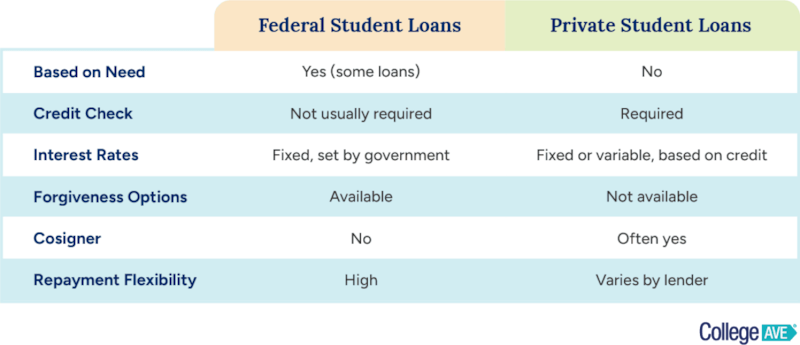
College Ave
The “Subsidized” Advantage
Pay special attention if your family qualifies for “subsidized” federal loans. If so, these loans should be prioritized. These loans are unique because the government pays the interest while the student is in school. Private student loans, by contrast, typically begin accruing interest the moment the funds are disbursed which can add to the total balance.
However, federal student loans have a cap, which is when private student loans can fill the financing gap. Private loans can cover 100% of the cost of attendance of college.
As families finalize plans for the upcoming academic year, taking the time to understand your borrowing options is crucial. The best loan option for your family may be different from the family next to you.
This story was produced by College Ave and reviewed and distributed by Stacker.